









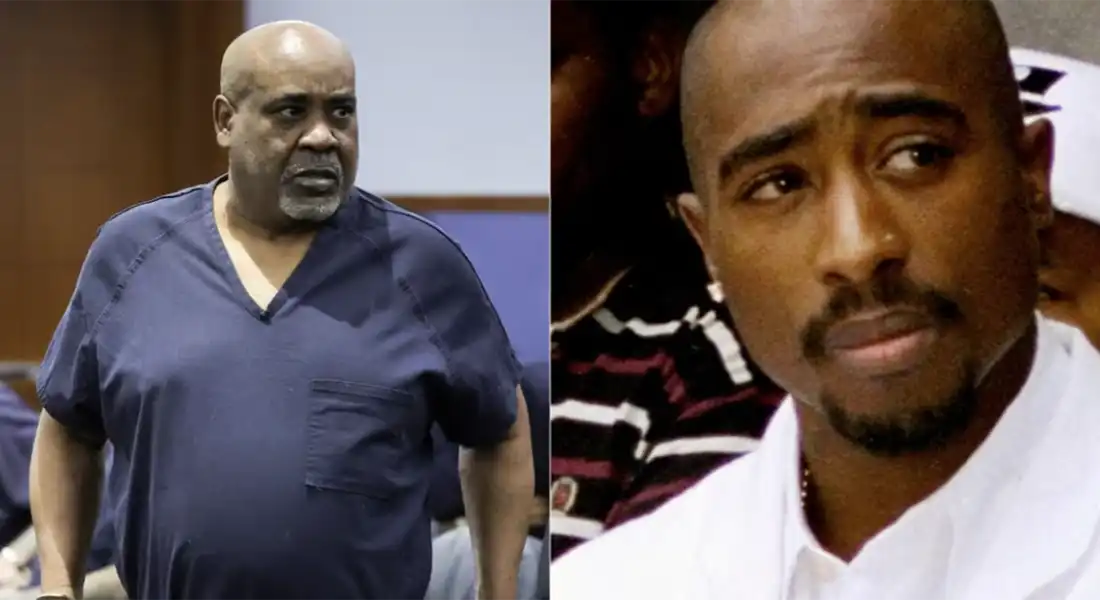
Nearly 30 years after Tupac Shakur was gunned down on a Las Vegas street, one of the most haunting mysteries in hip-hop history is finally being argued before a jury.
Duane “Keffe D” Davis, 63, is on trial in Nevada, accused by prosecutors of helping orchestrate the September 1996 drive-by shooting that killed Shakur at just 25 years old. Davis has pleaded not guilty and is not accused of being the person who fired the fatal shots. Prosecutors instead contend that he helped organize the retaliation that ultimately led to the rapper’s death.
For generations of hip-hop fans, the case is bigger than another celebrity trial.
Tupac’s death became one of the defining tragedies of 1990s Black music and culture—a story shaped by fame, violence, record-industry rivalries, street affiliations and decades of unanswered questions.
Now those questions are moving from documentaries, interviews, books and conspiracy theories into a courtroom.
The Night That Changed Hip-Hop
On Sept. 7, 1996, Shakur attended the Mike Tyson–Bruce Seldon fight at the MGM Grand in Las Vegas with Death Row Records co-founder Marion “Suge” Knight.
After the fight, Shakur and members of his group were involved in an altercation inside the casino with Orlando “Baby Lane” Anderson, Davis’ nephew.
Hours later, Shakur was riding in a BMW driven by Knight when a white Cadillac pulled alongside the vehicle near the Las Vegas Strip.
Gunfire followed.
Shakur was struck multiple times and rushed to a Las Vegas hospital. He died six days later, on Sept. 13, 1996.
His killing instantly became one of music’s most notorious unsolved crimes.
For years, there were theories.
There were accusations.
There were documentaries and books.
There were questions about gang retaliation, Death Row Records, the East Coast-West Coast feud and the people who were with Tupac during his final hours.
But no one was prosecuted.
Until Davis.
Why Keffe D Is on Trial
Davis became increasingly important to investigators in large part because of his own public accounts of what happened that night.
Over the years, he discussed the shooting in interviews and later wrote about the events in his 2019 memoir. He acknowledged being inside the Cadillac from which the shots were fired and has described obtaining the gun that was later used by someone in the vehicle.
Those statements became a major part of the case against him.
Prosecutors argue that Davis was a key participant in a revenge plot following the MGM Grand confrontation involving his nephew.
Under Nevada law, prosecutors do not necessarily have to prove that Davis personally pulled the trigger. They can seek to establish criminal responsibility by arguing that he helped plan, encourage or facilitate the killing.
Davis has denied criminal responsibility.
And his defense is now taking an unusual approach: challenging the credibility of Davis’ own previous statements.
Defense attorney Michael Sanft has argued that some of Davis’ public claims were exaggerated or fabricated for attention and financial benefit, including selling books and generating publicity. The defense maintains that prosecutors lack sufficient independent evidence tying Davis to an actual murder conspiracy.
That sets up one of the most unusual questions in the trial:
Should jurors believe what Davis himself repeatedly said about Tupac’s killing?
Tupac’s Final Injuries Detailed in Court
The emotional weight of the case became especially visible when prosecutors presented medical evidence concerning Shakur’s death.
A forensic pathologist testified about the gunshot wounds Tupac suffered and the internal injuries that ultimately proved fatal. Some members of Shakur’s family reportedly left the courtroom before autopsy photographs were displayed, while others remained.
The moment underscored something that can sometimes become lost after three decades of mythology surrounding Tupac:
He was a 25-year-old man whose family lost a son, brother, cousin and loved one.
The celebrity never erased the human loss.
For Tupac’s relatives, the trial may provide something that years of music documentaries and speculation never could—a formal public examination of the evidence.
Whether it provides closure is another question.
Why Tupac Still Matters Nearly 30 Years Later
There are few artists whose cultural presence has remained as powerful after death as Tupac Shakur’s.
He was more than a successful rapper.
His music repeatedly confronted racism, poverty, police brutality, misogyny, survival, Black family life and the contradictions facing young Black men in America.
Songs such as “Keep Ya Head Up,” “Dear Mama” and “Changes” showed a socially conscious artist thinking deeply about Black life.
At the same time, Tupac also embodied some of the contradictions he wrote about.
He could speak passionately about Black liberation and then become caught inside the violence, bravado and conflict surrounding the rap industry of the era.
He could be vulnerable and confrontational.
Political and provocative.
Poetic and unpredictable.
That complexity is one reason audiences continue debating his legacy.
Born in 1971 to parents connected to the Black Panther movement, Tupac grew up surrounded by political awareness. His music career eventually took him from Digital Underground to solo superstardom, producing albums including 2Pacalypse Now, Me Against the World and All Eyez on Me. He also established himself as an actor in films including Juice, Poetic Justice and Above the Rim.
His influence now reaches listeners who were not even born when he died.
The Trial Is Also About the Stories We Tell About Hip-Hop
For almost three decades, the Tupac murder existed somewhere between criminal investigation and cultural folklore.
Nearly everyone had heard a theory.
Was the killing gang retaliation?
Was it tied to the East Coast-West Coast rivalry?
Was the music industry involved?
Was there information law enforcement ignored?
Were witnesses afraid to talk?
Was the truth hiding in plain sight?
The trial does not promise to answer every question surrounding Tupac’s life or death.
But for the first time, prosecutors are attempting to establish criminal responsibility before a jury.
That matters.
Hip-hop has lost many artists to violence, from Tupac and The Notorious B.I.G. to generations of younger rappers whose lives ended before their careers could fully develop.
Behind every famous name is a family left grieving.
Behind every headline is a life that stopped.
And behind the mythology surrounding violent deaths are communities that have often had to watch unresolved cases become entertainment.
Nearly Three Decades of Waiting
Davis was arrested in 2023, 27 years after Shakur’s killing.
He is the only person ever charged in the case and the only surviving person authorities have publicly connected to the Cadillac involved in the shooting. The other men prosecutors associate with the vehicle have died.
That passage of time presents challenges for both sides.
Witness memories can fade.
Evidence can become harder to evaluate.
People connected to the original investigation have died.
And stories repeated over decades can become difficult to separate from established fact.
The prosecution points heavily to Davis’ own accounts.
The defense argues those accounts should not be trusted.
Jurors will ultimately have to decide what evidence proves beyond a reasonable doubt.
Tupac’s Legacy Is Already Decided
Whatever happens inside the Las Vegas courtroom, the verdict will not determine Tupac Shakur’s place in Black culture.
That decision was made long ago.
His music continues to be streamed, sampled, discussed and introduced to new generations.
His lyrics remain relevant in conversations about policing, poverty, racial inequality and Black resilience.
His image remains one of hip-hop’s most recognizable.
And his story remains inseparable from the rise of rap into one of America’s most influential cultural forces.
The trial may finally establish legal responsibility for what happened on that September night in 1996.
Or it may leave additional questions.
But nearly 30 years after Tupac Shakur’s death, the world is once again being reminded that behind the icon was a young Black artist whose voice became larger after his death than anyone could have imagined.
For his family, fans and the culture that continues to carry his music forward, this trial is not simply about revisiting hip-hop history.
It is about finally asking a jury to determine who should be held responsible for one of hip-hop’s deepest wounds.