









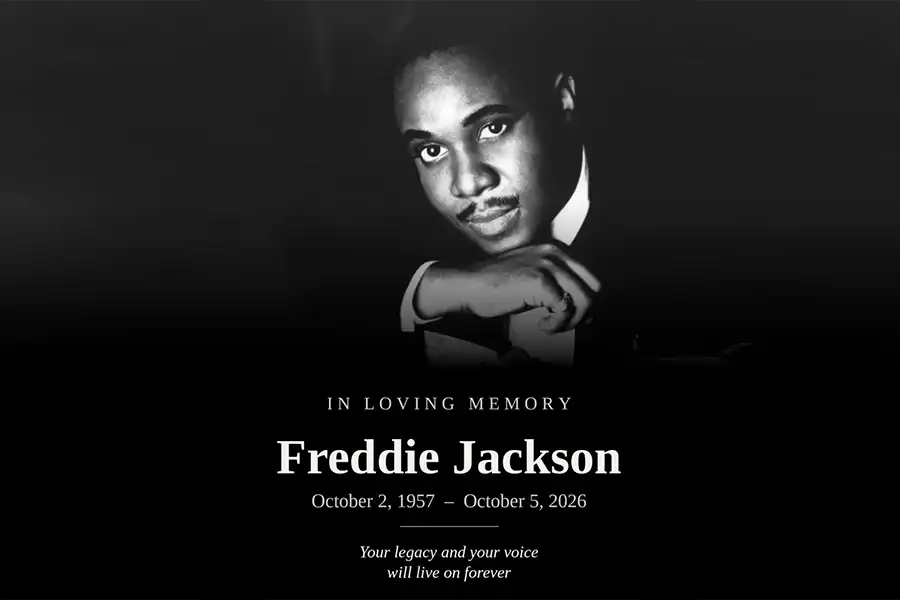
Freddie Jackson, the Grammy-nominated R&B singer whose smooth, powerful voice became the soundtrack to countless Black love stories, celebrations and memories, has died at age 69.
Jackson died Monday, October 5, 2026, just three days after celebrating his birthday. His family confirmed his passing in a statement shared through his official social media accounts on October 6. A cause of death has not been publicly disclosed.
“Freddie was more than a legendary voice,” his family said in announcing his death, remembering him as a kind and generous person who loved his fans, family, friends and music.
For generations of African Americans, however, Jackson represented more than a singer.
He represented a sound, a time and a particular expression of Black love.
A Harlem Beginning
Born and raised in Harlem, New York, Jackson’s musical foundation was deeply connected to the Black church. He began singing gospel at White Rock Baptist Church, where his early experiences helped shape the powerful and emotional vocal style that would eventually make him one of the defining voices of 1980s R&B.
His journey from Harlem and gospel music to the national R&B stage reflected a familiar path for many great African American singers.
The church was not simply a place of worship. For generations of Black musicians, it was also a training ground—a place where singers learned discipline, emotion, harmony and the ability to communicate with an audience.
Jackson carried those lessons with him.
The Voice Behind a Generation of Love Songs
Jackson broke through nationally in 1985 with his debut album, Rock Me Tonight. The title track became a No. 1 R&B hit and helped establish him as one of the leading voices of contemporary Black music.
Then came “You Are My Lady.”
For millions of listeners, the song became much more than a hit record. It became part of the soundtrack of relationships, weddings, anniversaries, dances and romantic memories.
Jackson followed that success with a remarkable collection of R&B hits, including “Tasty Love,” “Have You Ever Loved Somebody,” “Jam Tonight,” “Love Is Just a Touch Away,” “Nice ’N’ Slow” and “He’ll Never Love You (Like I Do).” Several reached the top of the R&B charts.
His first two albums, Rock Me Tonight and Just Like the First Time, were both certified platinum, and his work earned him two Grammy nominations in 1986.
But statistics only tell part of the story.
Jackson’s greatest accomplishment may have been the emotional connection he created with his audience.
What Freddie Jackson Meant to Black America
Freddie Jackson emerged during an important period in African American popular music.
The 1980s brought the rise of artists who were able to take Black musical traditions and bring them to increasingly large national audiences without losing the emotional character of soul and R&B.
Jackson was one of those artists.
His music gave Black audiences something deeply personal: songs that celebrated love from a Black perspective without apology or explanation.
His songs were played at family gatherings, weddings, cookouts, parties and quiet nights at home. They were requested on Black radio and became part of the soundtrack of relationships.
For many African Americans who came of age during the 1980s and early 1990s, hearing a Freddie Jackson song can immediately bring back a person, a place or a moment.
That is the power of music.
And that is why his passing feels larger than the loss of another recording artist.
He Helped Preserve the Tradition of Black Soul
Jackson’s career also represented something important about the evolution of Black music.
He came from gospel.
He sang R&B.
He embraced romance and soul.
And he remained committed to the emotional character of the music that had shaped him.
In a 1988 interview with the Los Angeles Times, Jackson spoke openly about the importance of preserving the soul in Black music and not sacrificing its character simply to achieve crossover success.
That philosophy is particularly meaningful when looking at his career today.
Jackson did not need to abandon his musical identity to become successful.
He proved that there was—and remains—a powerful audience for music rooted in Black cultural traditions.
A Career That Outlasted the Era
Although Jackson is closely associated with the golden era of 1980s R&B, his career did not end when the musical landscape changed.
He continued recording and performing for decades.
His final album, My First Love, was released in 2023, demonstrating that his relationship with music continued long after his biggest commercial successes.
That longevity is significant.
Many artists become associated with a particular decade. Jackson became associated with a particular feeling.
His voice remained recognizable.
His songs remained relevant.
And his audience continued to grow across generations.
Turning a Personal Challenge Into Awareness
In 2024, Jackson publicly revealed that he had been diagnosed with kidney disease. He also partnered with the National Kidney Foundation to raise awareness about kidney health.
At the time, Jackson spoke about facing the journey with openness and resilience.
While his family has not announced a cause of death, his willingness to publicly discuss his kidney disease gave visibility to an important health issue.
For Jackson, sharing his experience became another way of connecting with his audience.
The Loss of a Cultural Memory
The passing of Freddie Jackson is also a reminder that an entire generation of Black musical history is getting older.
The artists who provided the soundtrack to Black life in the 1970s, 1980s and 1990s are increasingly becoming elders of the culture.
Their stories matter.
Their music matters.
And the memories connected to their music matter.
For many Black Americans, Freddie Jackson’s music is tied to parents, grandparents, first loves, marriages, family reunions and moments that cannot be recreated.
A song such as “You Are My Lady” can transport someone back decades in a matter of seconds.
That is more than entertainment.
That is cultural memory.
His Voice Will Continue to Live
Freddie Jackson’s family asked fans to remember the love he had for his music and the people who supported him.
“To everyone who ever sang along, danced, or felt something when Freddie took the stage: thank you,” his family said. “You were family to him, and he carried your love with him always.”
That sentiment captures the relationship Jackson had with his audience.
He sang to people.
He sang about love.
And generations of listeners made his songs part of their own stories.
Freddie Jackson may be gone, but his voice will continue to play in homes, on playlists, at family gatherings and in the memories of those who grew up listening to him.
For the African American community, his legacy is not simply measured by chart positions or Grammy nominations.
It is measured by how deeply his music became part of our lives.
He gave Black America songs about love, devotion, heartbreak and celebration—and he gave those songs a voice that was unmistakably his own.
Freddie Jackson’s voice may have fallen silent, but the music remains.
And for generations to come, when the first notes of “You Are My Lady,” “Rock Me Tonight” or “Tasty Love” begin to play, millions will remember exactly who Freddie Jackson was.
A voice of Black love.
A voice of R&B.
A voice of a generation.
Rest in peace, Freddie Jackson.