









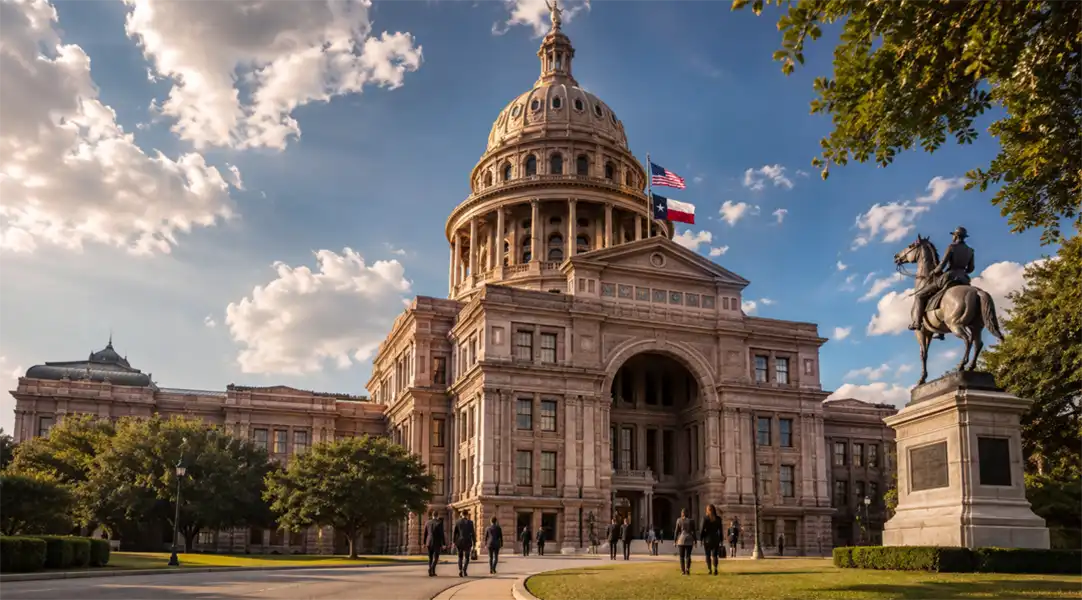
AUSTIN, Texas — Texas’ next state budget fight is already taking shape, and the decisions being made before lawmakers return to the Capitol could have significant consequences for historically Black colleges and universities, working families and communities across the state.
Gov. Greg Abbott, Lt. Gov. Dan Patrick and Texas House Speaker Dustin Burrows have directed state agencies, appellate courts and public universities to prepare budget requests for the next two-year spending cycle that are 3% below their baseline funding levels.
The directive applies to requests that will help shape the state budget covering September 2027 through August 2029. It does not mean every agency or university has already had its current funding cut by 3%. Instead, state leaders are calling the reduction a starting point for the next round of budget negotiations.
For African American communities in Houston and across Texas, the bigger question is where those reductions eventually fall — and whether the state’s push for additional property-tax relief produces the same benefits for renters, homeowners, college students and families who depend on public services.
Texas Leaders Say the Goal Is Affordability
Abbott, Patrick and Burrows say the tighter budget requests are intended to maintain fiscal discipline while giving lawmakers room to pursue additional affordability measures, particularly property-tax relief.
Texas already devoted approximately $51 billion of its current two-year budget to property-tax reductions, according to The Texas Tribune. The current $338 billion state budget runs through August 2027.
There are significant exemptions from the 3% directive.
Funding for K-12 public education and the state’s new private-school voucher program is protected, along with money required to maintain certain social programs established by state law, pension obligations and employee benefits.
The administration’s argument is straightforward: agencies should find efficiencies so Texas can continue lowering the cost of living without allowing government spending to grow unnecessarily.
But determining what counts as an efficiency and what becomes a reduction in services could become one of the major political questions facing lawmakers in 2027.
Texas HBCUs Have a Reason to Pay Attention
Higher education is one area where the directive deserves particular attention from Black Texans.
Texas Southern University in Houston and Prairie View A&M University northwest of Houston are both public historically Black universities.
Like other public universities across Texas, they operate within a state higher-education system that will be preparing funding requests as lawmakers decide what to appropriate in the next budget.
No specific 3% program cuts have been announced for Texas Southern or Prairie View A&M, and it would be premature to claim that either institution will lose a particular program, faculty position or service.
But higher-education budget experts say reductions of this type can force universities to make difficult choices.
Universities may respond by leaving vacant jobs unfilled, delaying equipment purchases, reducing travel and professional development, or spreading reductions among departments. Students could eventually notice larger classes or fewer staff members available to provide academic and administrative assistance, according to higher-education experts interviewed by The Texas Tribune.
The potential pressure comes at a time when funding at Texas four-year public universities already looks different from the national picture.
State and local support for Texas four-year institutions was about $7,288 per full-time-equivalent student in 2025, compared with a national average of $11,151, according to figures cited by The Texas Tribune.
That matters for HBCUs because these institutions have historically served students for whom affordability, financial aid, academic support and access can play a particularly important role in whether they enter college and ultimately graduate.
Prairie View and Texas Southern Are More Than Campuses
For Greater Houston, the impact of the state’s public HBCUs extends well beyond students sitting in classrooms.
Prairie View A&M estimates that its university operations, students, employees and associated activity generate nearly $936 million in total economic benefit to the Greater Houston area and support thousands of jobs.
Texas Southern similarly occupies an important place in Houston’s Third Ward and in the city’s civic, professional and cultural history.
Graduates of Texas HBCUs work throughout government, education, medicine, law, business, engineering and public service.
That means a debate about higher-education funding is also a debate about workforce development, economic mobility and the pipeline that produces many of the professionals serving Black communities across Texas.
For AframNews readers, this is why the details of university budget requests should matter long before lawmakers cast their final votes.
Property-Tax Relief Does Not Reach Every Household the Same Way
The other side of the debate is property taxes.
For Texans who own their homes, additional property-tax relief can provide meaningful savings.
Texas currently provides a $140,000 school-district homestead exemption, with additional relief available to seniors and people with disabilities.
But a homestead exemption directly benefits people who own their primary residence.
Renters do not receive that exemption themselves.
That distinction deserves attention in African American communities because homeownership remains deeply unequal.
Nationally, the Black homeownership rate was 44.0% in the first quarter of 2026, compared with 75.0% for non-Hispanic White households, according to the U.S. Census Bureau.
The situation is particularly concerning in Houston.
Rice University’s Kinder Institute reported this summer that the city lost approximately 7,750 Black homeowner households in 2024, a 5.4% decline. At the same time, 52.6% of Houston renters were considered cost-burdened, meaning more than 30% of their income went toward housing.
Those numbers create an important policy question.
If Texas continues placing enormous emphasis on property-tax reductions, what affordability policies will reach households that do not own property?
For many Black Houston families, the cost-of-living conversation is not limited to a property-tax bill.
It includes:
rent, homeowners insurance, electricity, groceries, transportation, childcare and healthcare.
That does not make property-tax relief unimportant. Black homeowners benefit from it just like other homeowners.
But it means lawmakers should consider whether the state’s affordability strategy reaches families across different housing circumstances.
Houston’s Black Homeownership Decline Raises the Stakes
The issue is particularly important because homeownership has historically been one of the primary ways American families build generational wealth.
The Kinder Institute found that Harris County overall experienced its largest homeownership decline since 2010, while Houston experienced a record loss of Black homeowner households. Homeowners insurance also became substantially more expensive, increasing 17% in Harris County in one year, according to the institute.
For historically Black neighborhoods, declining homeownership can have consequences beyond individual household finances.
It can affect:
generational wealth
neighborhood stability
property ownership
community institutions
small-business development
and ultimately the ability of families to pass assets to the next generation.
That makes the state budget debate about more than whether Texans receive another property-tax reduction.
It raises the larger question of what Texas is doing to help families reach homeownership in the first place.
State Services Are Another Area to Watch
The 3% directive should not be interpreted as an across-the-board 3% reduction in Medicaid, SNAP or other benefits.
Funding needed to maintain certain legally required social programs is exempt from the reduction target.
However, the agencies administering major programs will still be operating in a difficult budget environment.
Texas is also facing potentially significant new costs associated with the administration of the Supplemental Nutrition Assistance Program, or SNAP.
Changes at the federal level could leave Texas responsible for substantially more administrative expenses and penalties beginning in 2027. State officials have estimated that the additional burden could total approximately $826 million if current error-rate problems are not resolved.
That does not mean Texans are automatically losing food assistance.
But it means lawmakers could enter the next session with hundreds of millions of dollars in new obligations competing with tax cuts, higher education, healthcare, transportation and other priorities.
For residents who interact with state agencies, staffing matters too.
An agency may technically preserve a benefit while still experiencing longer telephone waits, slower application processing or reduced administrative support if vacancies go unfilled.
Those are the less visible consequences Texans should watch as agencies turn the 3% target into actual budget proposals.
Community Colleges Could Feel Pressure Too
The higher-education conversation also extends beyond four-year universities.
Texas community colleges are already confronting funding pressures under the state’s performance-based financing system.
Some colleges are seeing significant reductions because student outcomes exceeded the funding levels lawmakers originally projected. Nearly a dozen colleges faced state-funding declines of more than 15%, according to recent Texas Tribune reporting.
That matters in Houston, where community colleges provide affordable pathways into nursing, skilled trades, technology, transportation, healthcare and other careers.
For working adults and first-generation college students, those institutions are often the first point of entry into higher education.
The 3% Number Is Not the Final Budget
There is an important distinction for readers to remember.
Texas has not enacted the 2028-29 budget yet.
The 3% reduction is an instruction governing what agencies and universities initially request.
Lawmakers will ultimately decide how much money each agency, university and program receives when the Legislature meets in 2027.
Institutions can also make requests for funding beyond their base budgets and make the case to lawmakers that particular programs deserve additional support.
That means there is still time for communities to pay attention.
Budget decisions are political decisions because they determine which priorities receive public resources and which do not.
What Black Texans Should Watch Next
For African American communities, at least four questions deserve close attention heading toward the 2027 legislative session.
First: What happens to Texas Southern and Prairie View A&M?
Their final legislative appropriations requests will show which programs university leaders consider essential and where financial pressure may exist.
Second: Will affordability policy go beyond property taxes?
Tax relief matters to homeowners, but renters and families trying to become homeowners face a different set of challenges.
Third: Will administrative reductions affect access to state services?
The public should watch staffing, processing times and customer service at agencies responsible for health, food assistance, licensing and other programs.
Fourth: Which communities have a voice in the final budget?
The first budget request is only the beginning. Legislative committees, public testimony, elected representatives and negotiations between the House, Senate and governor will ultimately determine the state’s priorities.
A Budget Is Also a Statement of Priorities
Texas remains one of the nation’s largest and fastest-growing states.
Its leaders are simultaneously trying to reduce taxes, maintain public services, support education, build infrastructure and respond to rising costs.
Those goals will inevitably compete for money.
For the African American community, the measure of the next state budget should therefore go beyond whether spending is larger or smaller.
The more important questions are:
Who benefits?
Who absorbs the reductions?
Are HBCUs positioned to continue educating the next generation?
Are working families receiving relief regardless of whether they rent or own?
And are communities that have historically faced barriers to wealth and opportunity moving forward — or being asked to do more with less?
Those are the questions AframNews will be watching as Texas lawmakers begin shaping the next state budget.