








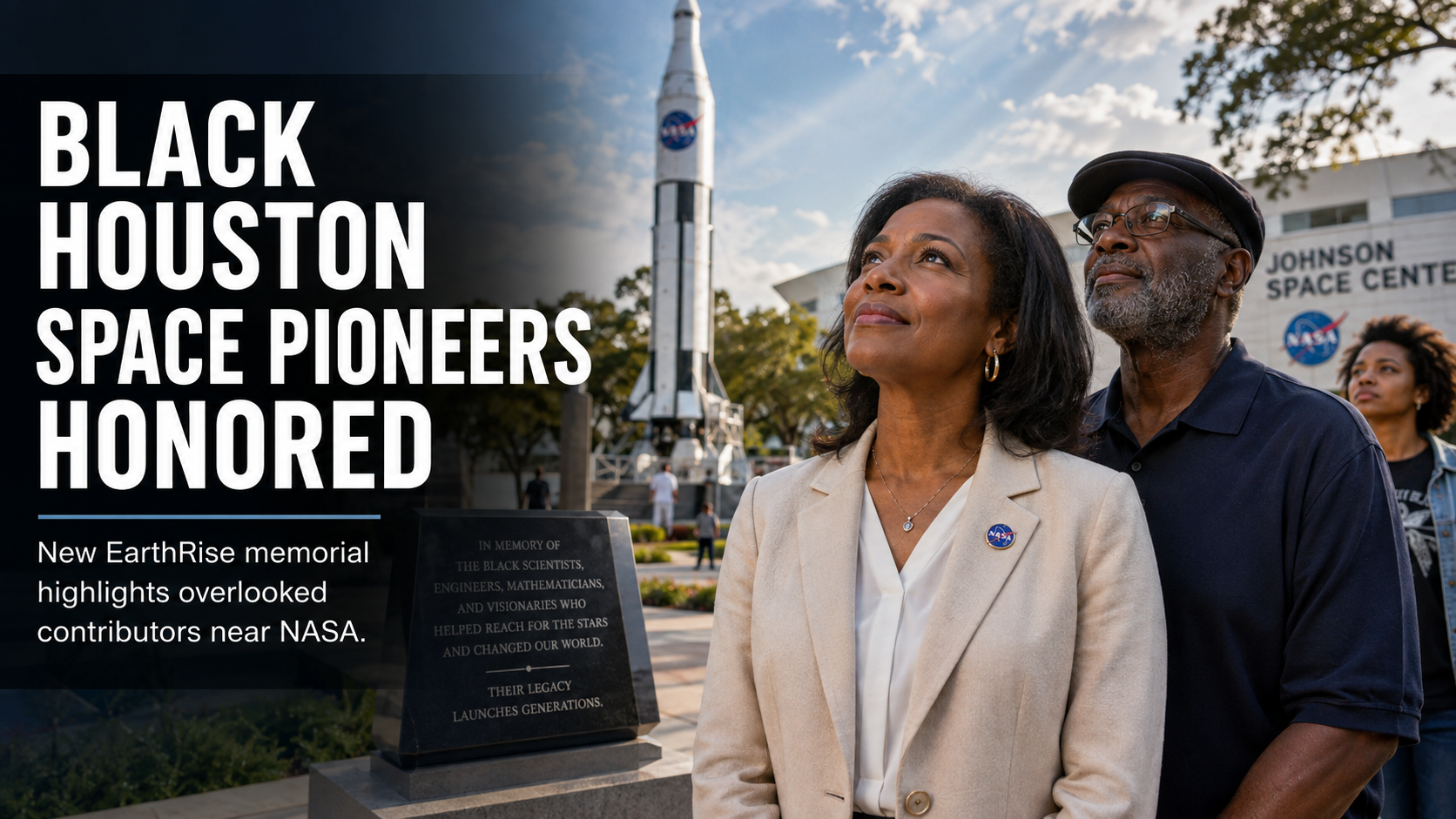
NASSAU BAY, Texas — Just blocks from NASA’s Johnson Space Center, a new public monument is making sure the Black men and women who helped America reach for the stars are no longer left in the shadows of space history.
The EarthRise monument, located at St. Thomas the Apostle Episcopal Church in Nassau Bay, was officially dedicated on Aug. 16. The public art installation honors Black Americans, women and other historically underrepresented people whose work helped advance the nation’s space program.
The memorial stands only about four blocks from NASA’s Mission Control, placing the stories of Black astronauts, engineers, scientists and other pioneers in the heart of the Houston-area community that became synonymous with American space exploration.
One of the monument’s most striking features is its stained-glass design. Roughly 50 people of color are represented throughout the mosaic, surrounded by images inspired by space exploration. The structure includes an arched canopy and a capsule-inspired centerpiece featuring eight panels that recognize individuals and groups whose achievements changed the course of the American space program.
Among those recognized are Ed Dwight, an early Black astronaut candidate; Robert Henry Lawrence Jr., the first African American selected as an astronaut by a national space program; scientist George Carruthers; NASA administrator and civil rights advocate Ruth Bates Harris; astronaut Dr. Bernard Harris Jr.; astronaut Sunita Williams; former astronaut and NASA Administrator Charles Bolden Jr.; and NASA Astronaut Group 8, the groundbreaking 1978 class that included the first Black and female astronauts selected for NASA’s Space Shuttle era.
The memorial also recognizes pioneers whose contributions came from behind the scenes. Among the faces incorporated into EarthRise is legendary mathematician Katherine Johnson, whose calculations were critical to early U.S. space missions and whose life later reached millions through the story that inspired Hidden Figures.
For Houston’s Black community, EarthRise represents more than another space-related attraction. It is a public acknowledgment that America’s journey beyond Earth was never the accomplishment of one race, one gender or one group.
Former NASA Administrator Charles Bolden, who has long-standing ties to St. Thomas the Apostle Episcopal Church, attended the dedication. Bolden flew four Space Shuttle missions before later becoming the first Black administrator of NASA. He said he hopes young people who visit the monument will recognize that there are many paths into science, exploration and public service.
The approximately $125,000 project was funded through the Talbot Foundation of the Episcopal Diocese of Texas. Genesis Art Collaborative was selected to design the installation following an international competition.
EarthRise is free and open to the public year-round.
Its location carries particular significance. NASA transformed Houston into “Space City,” but many of the Black scientists, engineers, mathematicians, administrators and astronauts who helped make that history possible received far less public recognition than their accomplishments deserved.
EarthRise is helping change that.
For the next generation of Black children who stand beneath its stained glass and see faces that look like their own among the pioneers of American space exploration, the memorial delivers a powerful message: Black history is space history, too.