


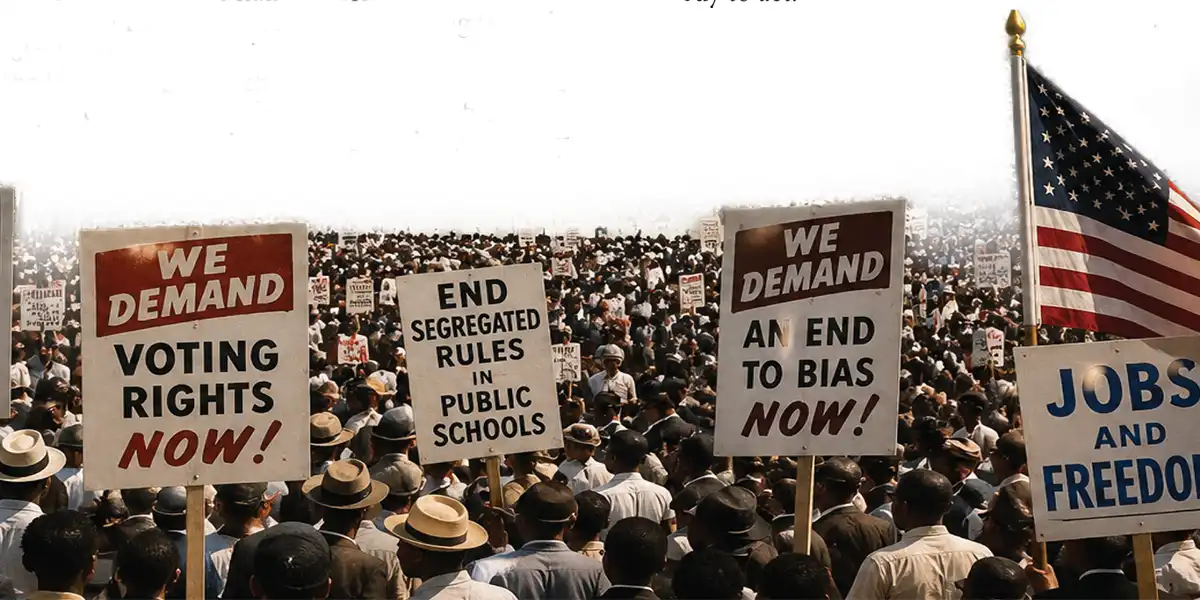

The March on Washington for Jobs and Freedom, held on August 28, 1963, was one of the most important events of the American Civil Rights Movement. More than 200,000 people gathered in Washington, D.C., to demand racial equality, economic opportunity, and an end to segregation and discrimination. The peaceful demonstration brought together civil rights leaders, religious groups, labor organizations, students, and ordinary citizens from across the country.
The march was organized by several major civil rights leaders, including A. Philip Randolph, Bayard Rustin, Martin Luther King Jr., John Lewis, Whitney Young, James Farmer, and Roy Wilkins. Their goal was to pressure the federal government
to take stronger action to protect the rights of Black Americans. Participants called for better employment opportunities, fair wages, voting rights, integrated schools, and equal treatment under the law.
The event became especially famous because of Martin Luther King Jr.’s “I Have a Dream” speech, delivered from the steps of the Lincoln Memorial. His message called for a future in which people would be judged by their character rather than the color of their skin. The speech captured the hopes of millions and became one of the defining moments of the civil rights era.
The March on Washington helped build national support for civil rights legislation. Less than a year later, Congress passed the Civil Rights Act of 1964, which outlawed segregation in many public places and prohibited discrimination based on race, color, religion, sex, or national origin. The Voting Rights Act of 1965 followed, strengthening federal protections for voting rights.
The legacy of the March on Washington continues today. It demonstrated the power of peaceful pro- test and collective action and showed how ordinary people could come together to demand meaningful change. The march remains a symbol of courage, hope, equality, and the continuing struggle for justice.
The history of the March on Washington grew out of decades of organizing against racial discrimination, segregation, and economic inequality. One of its most important roots was the work of A. Philip Randolph, a labor leader who had called for a major demonstration in Washington as early as 1941. Randolph wanted to pressure President Franklin D. Roosevelt to address discrimination against Black workers in the defense industry. Although that planned march was canceled after Roosevelt issued an executive order banning discrimination in defense employment, the idea of mass action in Washington remained influential.
By the early 1960s, the civil rights movement had gained national attention through events such as the Montgomery Bus Boycott, student sit-ins, Freedom Rides, and voter-registration campaigns. Civil rights organizations increasingly demanded stronger federal action. In 1963, Randolph and Bayard Rustin helped organize the March on Washington for Jobs and Freedom, bringing together major civil rights, labor, religious, and community organizations.
On August 28, 1963, hundreds of thousands of people traveled to Washington, D.C. Participants gathered near the Lincoln Memorial and peacefully called for jobs, freedom, voting rights, fair wages, and an end to segregation. The march demonstrated the enormous national support for civil rights and placed pressure on Congress and President John F. Kennedy to act.