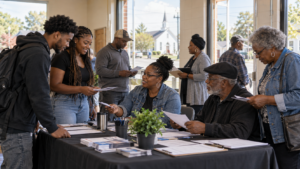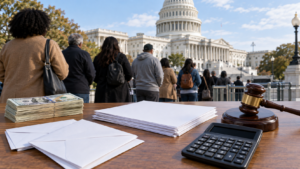








There are moments in American history when a court decision does more than interpret the law—it reshapes the lived reality of millions. For many in the African American community, the latest Supreme Court ruling on congressional maps feels like one of those moments. The question being asked in barbershops, churches, and living rooms is not complicated: if the rules keep changing, can the outcome still be trusted?
The foundation of this concern lies in something most Americans rarely think about—district lines. On paper, redistricting is a routine process meant to reflect population changes. In practice, it has often been used as a political weapon. For decades, Black voters have had to fight not just for access to the ballot, but for their votes to actually carry weight once cast. The Voting Rights Act was designed to protect against exactly this kind of manipulation.
But critics argue that the Supreme Court’s recent decision has made it harder to challenge maps that dilute Black voting strength. By narrowing how the law can be applied, the ruling raises the burden of proof for communities trying to show that their political power is being intentionally weakened. In simple terms, it’s no longer enough to show that the outcome looks unfair—you now have to meet a higher legal standard to prove it was designed that way.
That shift may sound technical, but its impact is deeply human. In states like Louisiana, where Black residents make up a significant portion of the population, representation has long been a point of contention. Advocates have argued that congressional maps should reflect that reality more accurately. Yet time and again, district lines have been drawn in ways that split Black communities apart or pack them into limited districts, reducing their overall influence. The concern now is that this ruling could make those practices harder to stop.
For elders who remember the civil rights movement, this moment carries a painful sense of déjà vu. They remember when voting barriers were obvious—poll taxes, literacy tests, intimidation. Today, the barriers are more subtle, hidden in legal language and political strategy. But the outcome, they fear, may be the same: voices diminished, power diluted, and communities left without fair representation.
It’s important to acknowledge that not everyone sees the ruling the same way. Some legal experts argue that the Court is simply clarifying how the law should be applied, ensuring that claims of discrimination are backed by strong evidence. They believe that states should have flexibility in drawing maps as long as they follow constitutional guidelines.
However, for many African Americans, the issue is not just about legal theory—it’s about trust. Trust in a system that has historically excluded them. Trust in institutions that have often required pressure, protest, and sacrifice to produce change. When that trust is shaken, it raises deeper questions about participation itself.
If people begin to feel that their vote is being weakened before it is even cast, what happens to engagement? What happens to turnout? What happens to the belief that democracy is truly representative? These are not abstract concerns. They are real risks with real consequences. At its core, this debate is about more than maps. It is about power—who has it, who keeps it, and who gets to challenge it. The Voting Rights Act was meant to level that playing field, to ensure that no group could be systematically sidelined. If that protection is weakened, even slightly, the balance begins to shift.
And history has shown us what happens when that balance is lost. The path forward will not be easy, but it is clear. Communities must stay informed, engaged, and active. Legal challenges will continue, advocacy efforts will grow, and new strategies will emerge. The fight for fair representation has never been a one- time victory—it has always been an ongoing struggle.
The real question now is not just whether the system is fair, but whether we are willing to demand that it be. Because democracy only works when the people believe in it— and when every voice, regardless of race or background, has a fair and equal chance to be heard.