








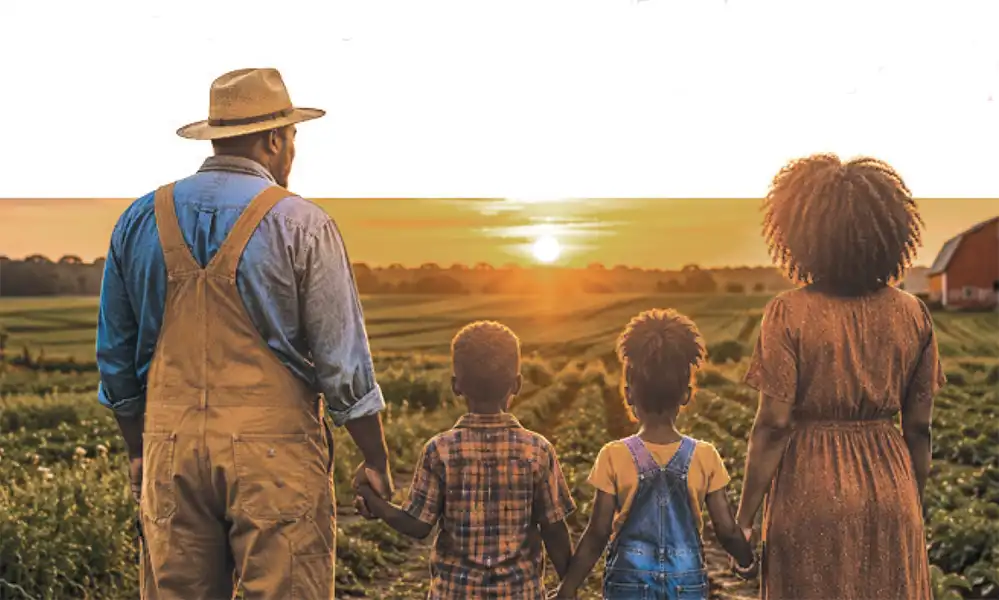
In 1910, Black farmers made up fourteen percent of all farmers in the United States. Today that number has collapsed to less than two percent of the farming population. That is not a footnote in agricultural history. That is a story of stolen land, denied loans, and a federal government that built its farm pro- grams on the backs of Black families and then locked those same families out of the wealth those programs created. Elizabeth Warren for Senate (https://elizabeth-warren.com/plans/equity- farmers-of-color) The most recent Census of Agriculture confirms the trend is getting worse, not better. In the five years leading up to 2022, the nation lost seven percent of all farms, while Black farmers lost nearly thirteen percent, the steepest decline of any racial group tracked.
The actual number of Black or African American farmers fell from 35,470 in 2017 to 32,653 in 2022. This is happening while white farmers operate ninety five percent of the nation’s nearly two million farms and Black farmers operate less than two percent. Capital B News (https://capitalbnews.org/black-farmsusda-report/) Land is money, and Black farmers have been bled of both.
A study published by the American Economic Association found Black farmers lost 326 billion dollars in land between 1920 and 1997. Other estimates put the total land loss over the last century at roughly 16 million acres, much of it lost through discrimination carried out by the very federal agencies charged with serving these farmers. That is generational wealth that never made it to the next generation. That is inheritance that never arrived. Public Integrity (https://publi- cintegrity.org/inequality-poverty-opportunity/the- heist/ usda-equity-black-farmers-pigford-glickman-toxic-debt/) Essence (https://www.essence. com/news/black-farmers- usda-program-canceled/) The funding gap is not a relic of the past. It is happening right now. In 2022, non-Hispanic Black farms received an aver age of 7,774 dollars in government payments, compared to 16,417 dollars for non- Hispanic white farms, a fifty three percent gap. During the pandemic, Black farmers received less than half of what white farm- ers received under the Coronavirus Food As- sistance Program, and despite accounting for 1.7 percent of all farms, Black operated farms received just 0.17 per- cent of total payments under that program.
As recently as 2022, USDA approved loans for seventy two percent of white applicants but only thirty six percent of Black applicants. Mysite (https://www.phantomecology.com/post/black-farmers-receive-less-than-0-3-of-federal-agriculture- payments) This is what happens when access to capital, access to con- tracts, and access to information are rationed along racial lines. It happened after the Pigford v. Glickman lawsuit forced the government to admit what Black farmers had said for de- cades. More than 15,000 farmers received lump sum payments of 50,000 dollars, and the federal government eventually returned more than two billion dollars to claimants. But less than three percent of all claimants, just 425 people, ever received the debt relief that was supposed to fix the underlying problem.
The check was not the cure. The debt stayed. The land kept slipping away. Public Integrity (https://publicinteg- rity.org/inequality- poverty-opportunity/ the-heist/usda-equity- black-farmers-pigford-glickman-toxic-debt/) NAACP Legal Defense Fund (https://www.naacpldf.org/case-issue/ black-farmers-faq/) Even the recent efforts at repair have been frag- ile. In 2022, roughly 900 million dollars meant for Black, Native American, Latino, Asian, and Native Hawaiian farmers through the American Rescue Plan Act was blocked by the courts before it could reach a single farmer.
A newer 300 million dollar program built to help underserved farmers gain access to land, capital, and markets was terminated this year, with the USDA sending cancellation notices to 49 of the 50 organizations holding those contracts. Every time Black farmers get close to structural repair, the door gets slammed shut again. Heller School (https://heller. brandeis.edu/iere/news/ press-releases/2023-07-13-pigford-debt.html) Essence (https://www. essence.com/news/ black-farmers-usda- program-canceled/) This is where our community has to make a decision. We cannot keep waiting on Washington to fix what Washington broke. We have to build our own pipeline into agriculture, land ownership, food production, and the government contracting world that controls so much of this industry. Agriculture is not a relic of the past for Black people. It is a path to the future. Land ownership builds wealth that survives a bad job market, a bad economy, or a bad boss. Farming and agribusiness give our young people a direct line into food policy, environmental policy, and the federal contracting apparatus that spends billions of dollars every year.
Our HBCUs and land grant institutions already have the infrastructure. What is missing is the pipeline connecting our children to it, early and often. We need our churches, our civic organizations, and our schools teaching agriculture the way they teach basketball and business. We need our young people learning how to read a farm loan application the same way they learn to read a lease or a contract. We need Black owned agribusinesses competing for government contracts, not standing on the outside watching them get awarded to everyone else. Food access, food sovereignty, and land ownership are civil rights issues. They always have been.
The Culture Commission Coalition will continue pushing for account- ability from USDA, for restored funding for underserved farmer programs, and for real oversight of how contracts and loans get distributed. But policy change moves slowly, and our community cannot afford to wait on it alone. The land is still out there. The knowl- edge is still out there. What we need now is the will to reclaim both. Our ancestors farmed this land in bondage and built wealth from nothing. We can farm it in freedom and build wealth on purpose. The choice, and the work, is ours.