








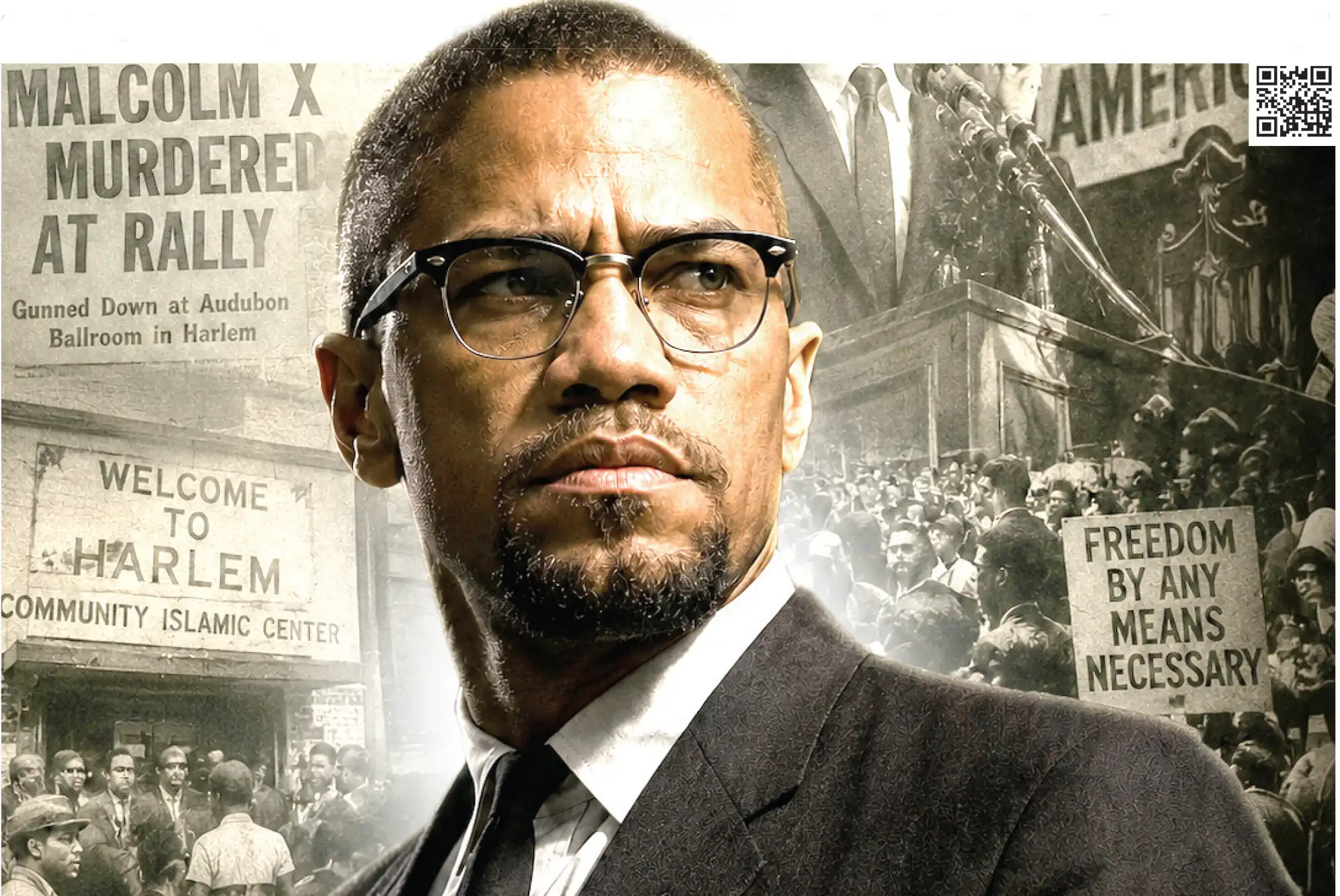
By: Roy Douglas Malonson
Malcolm X was one of the most important leaders in American history. He was a man who changed his life many times to try and make the world a better place for Black Americans. While some people found his ideas difficult or scary at the time, his message of “Black Pride” and standing up for your rights is still very important today.
A Difficult Start
Malcolm X was born Malcolm Little in 1925 in Omaha, Nebraska. His childhood was very hard. His father was a minister who believed that Black people should be treated fairly, but this made local hate groups angry. When Malcolm was young, his family’s house was burned down, and his father died under mysterious circumstances.
Because of all this stress, Malcolm’s mother became very ill, and Malcolm was sent to live in foster homes. Even though he was a great student and wanted to be a lawyer, a teacher told him that a Black person could never do that. This hurt Malcolm deeply and made him lose interest in school. He eventually moved to big cities like Boston and New York, where he got into trouble and was sent to prison when he was 20 years old.
A New Beginning in Prison Prison is where Malcolm’s life
changed forever. He started reading every book he could find in the prison library. He also learned about a group called the Nation of Islam. This group taught that Black people should be proud of their history and should start their own businesses and schools instead of trying to fit into a society that didn’t want them.
When he joined the group, he changed his last name to “X.” He did this because “Little” was a name given to his ancestors by slave owners. The “X” stood for his real African name that had been lost. When he left prison, he became a minister and a powerful speaker.
The Fight for Justice
During the 1950s and 1960s, the Civil Rights Movement was happening. Leaders like Dr. Martin Luther King Jr. believed in “non-violence,” which meant protesting peacefully even if people were mean to them. Malcolm X had a different idea. He believed in “human rights” and said that Black people should defend themselves “by any means necessary.”
He told Black Americans that they were beautiful and strong. He encouraged them to love themselves and their culture. Because he was such a good speaker, thousands of people joined the Nation of Islam to hear him talk. He became a hero to many people who felt that the government wasn’t doing enough to protect them from racism.
A Change of Heart
In 1964, Malcolm X left the Nation of Islam after having some disagreements with its leaders. He decided to take a trip to a city called Mecca in Saudi Arabia. This trip is called a Hajj, and it is very important for Muslims. While he was there, he saw people of all different colors— white, Black, and brown— praying together and treating each other like brothers. This changed his mind about many things. When he came back to America, he started a new group. He still fought for Black rights, but he began to believe that people of all races could work together to end racism. He even changed his name again to El-Hajj Malik El-Shabazz.
His Final Days and Legacy
Sadly, Malcolm X’s life was cut short. On February 21, 1965, he was killed while giving a speech in New York City. He was only 39 years old. Even though he died young, his ideas did not die with him.
Malcolm X left behind a huge legacy. Here are a few ways he changed the world:
Black Pride: He taught Black people to be proud of their skin, their hair, and their African roots.
Self-Reliance: He believed communities should take care of themselves and support their own businesses.
Human Rights: He took the fight for equality to a global level, arguing that it wasn’t just a problem in America, but a problem for the whole world.
Today, we remember Malcolm X as a man who wasn’t afraid to speak the truth, even when it was dangerous. He showed that it is never too late to change yourself for the better and that everyone deserves to be treated with dignity. His autobiography is still one of the most read books in schools today, helping new generations understand the long struggle for freedom in America.