








By: Roy Douglas Malonson
In 1951, a third-grader named Linda Brown walked through the switching yards of Topeka, Kansas, to board a bus to Monroe Elementary, a segregated school for Black children. Her walk was not just long; it was dangerous. Yet, just four blocks from her home sat Sumner Elementary, a well-funded, safe school reserved exclusively for white children. When her father, Oliver Brown, attempted to enroll Linda at Sumner, the school refused. This local act of rejection became the catalyst for Brown v. Board of Education of Topeka (1954), a landmark United States Supreme Court case that shattered the legal spine of state-sanctioned segregation. More than seventy years later, while Brown fundamentally re-engineered the American legal landscape, its promises of true educational equity remain unfulfilled, casting a long shadow over modern society.
To understand the impact of the Brown decision, one must examine the legal hurdle it had to clear. For nearly sixty years, the law of the land was dictated by the 1896 ruling in Plessy v. Ferguson, which established the “separate but equal” doctrine. This doctrine claimed that racially segregated public facilities did not violate the Fourteenth Amendment’s Equal Protection Clause as long as the facilities were equal. In reality, facilities for Black Americans were grossly underfunded, decaying, and intentionally marginalized.
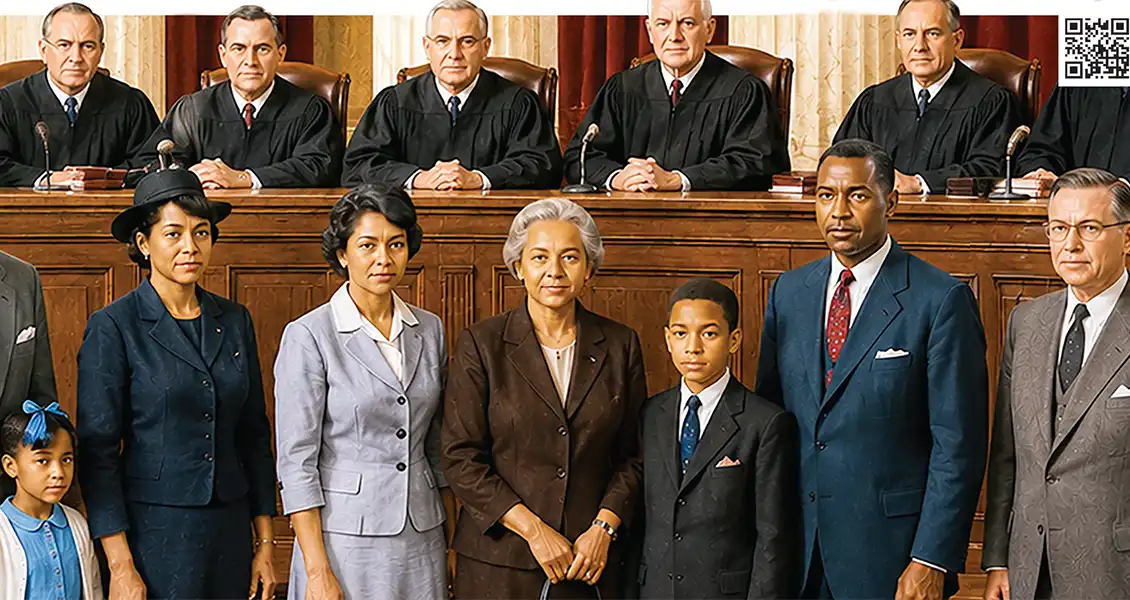
When the Brown case reached the Supreme Court, combining lawsuits from Delaware, Kansas, South Carolina, Virginia, and Washington, D.C., civil rights attorney Thurgood Marshall argued a revolutionary point. He did not just argue that Black schools had inferior buildings or fewer books; he argued that the very act of separation was harmful. To prove this, Marshall utilized social science data, most notably the “doll tests” conducted by psychologists Kenneth and Mamie Clark. These tests revealed that Black children in segregated environments often chose white dolls over Black dolls, assigning negative traits to the Black dolls. On May 17, 1954, Chief Justice Earl Warren delivered a unanimous 9-0 decision, declaring that “in the field of public education, the doctrine of ‘separate but equal’ has no place. Separate educational facilities are inherently unequal.”
The immediate effect of Brown was a seismic shift in American civil rights. It served as the legal blueprint for dismantling Jim Crow. If segregation in public schools violated the Constitution, then segregation on public buses, in libraries, at lunch counters, and in courtrooms was equally indefensible. The moral and legal momentum of Brown directly fueled the Civil Rights Movement, paving the way for the Civil Rights Act of 1964 and the Voting Rights Act of 1965. Furthermore, the legal logic of Brown expanded beyond race, serving as the foundation for modern advocacy regarding gender equity, disability rights, and marriage equality.
However, the transition from legal decree to societal reality has been fraught with resistance. The Supreme Court’s follow-up ruling in 1955 (Brown II) ordered desegregation to proceed with “all deliberate speed”—a vague phrase that segregationists exploited to delay integration for decades. In the modern era, the nation faces a sobering reality: public schools are heavily re-segregating. While de jure segregation (segregation enforced by law) is dead, de facto segregation (segregation caused by residential socioeconomic patterns) is thriving.
Today, millions of minority children attend schools that are almost entirely non-white. This modern segregation is deeply tied to the American housing market. Decades of historical redlining, discriminatory lending practices, and suburban “white flight”
have created deeply divided neighborhoods. Because public school boundaries are tied to geographic ZIP codes, segregated neighborhoods naturally produce segregated schools.
Crucially, because American public education relies heavily on local property taxes for funding, neighborhoods with lower property values generate significantly less revenue for their schools. This creates a systemic funding gap. Wealthy, predominantly white suburban districts frequently feature state-of-the-art technology, advanced placement courses, and highly compensated teachers, while urban and rural