








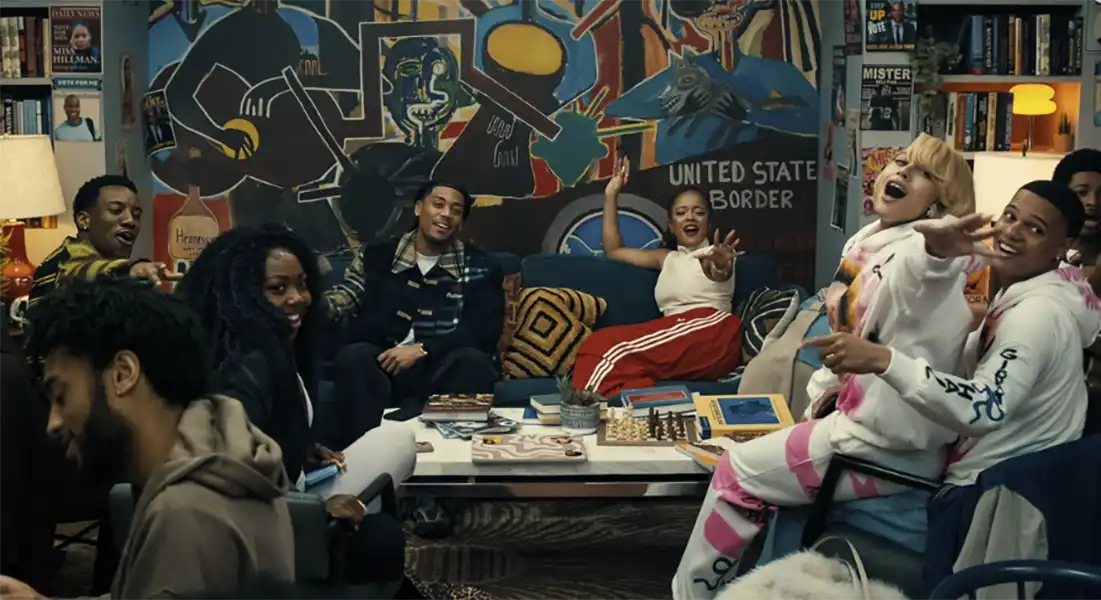
Nearly four decades after A Different World introduced millions of television viewers to the fictional Hillman College, class is about to be back in session.
Netflix will premiere its new A Different World sequel series on Sept. 24, 2026 — exactly 39 years after the original sitcom debuted on NBC on Sept. 24, 1987. The continuation brings a new generation of students to Hillman while reconnecting audiences with characters who helped make historically Black college life visible to families across America.
For longtime fans, the return offers nostalgia.
For historically Black colleges and universities, it could offer something more important: another opportunity to show millions of young people what an HBCU education, culture and community can look like.
That possibility is not theoretical.
The original A Different World aired during a period when HBCU enrollment climbed substantially, and members of the cast and creative team have spent decades hearing from viewers who say Hillman influenced where they went to college, what they studied and even the careers they chose.
Now, with a new generation growing up on streaming platforms rather than Thursday-night network television, Hillman College has another chance to make the HBCU experience part of the national conversation.
A New Generation Arrives at Hillman
The new series centers on Deborah Wayne, played by Tony Award winner Maleah Joi Moon.
Deborah is the youngest daughter of two of the original show’s most beloved characters, Dwayne Wayne and Whitley Gilbert, played by Kadeem Hardison and Jasmine Guy.
She arrives at Hillman as a freshman trying to establish an identity separate from the legacy of her famous parents.
Joining Moon in the new student cast are Alijah Kai as Rashida, Chibuikem Uche as Kojo, Cornell Young IV as Shaquille, Jordan Aaron Hall as Amir and Kennedi Reece as Hazel. Netflix describes the group as a new generation representing different dimensions of Black life on a contemporary HBCU campus.
A number of familiar faces are also returning.
Guy and Hardison reprise their roles as Whitley and Dwayne, while Cree Summer returns as Freddie Brooks, Darryl M. Bell as Ron Johnson, Dawnn Lewis as Jaleesa Vinson-Taylor, Charnele Brown as Dr. Kimberly Reese Boyer and Glynn Turman as Colonel Bradford Taylor.
The returning cast also includes Jenifer Lewis, Jada Pinkett Smith, Karen Malina White and Ajai Sanders. New additions include Method Man, Tichina Arnold and Raven Goodwin.
Behind the camera, one of the most important links to the original series is also back.
Debbie Allen, who helped reshape A Different World after its first season and became its primary director and producer, returns as an executive producer and director. Felicia Pride serves as showrunner, writer and executive producer.
Victor Blackwell Goes Back to Hillman
CNN anchor Victor Blackwell recently visited the set for First of All with Victor Blackwell and interviewed both returning cast members and the new generation of Hillman students.
For Blackwell, the story was personal.
Introducing the segment, he said the original show inspired many young people — including him — to attend an HBCU.
That is precisely why the return of A Different World could extend beyond entertainment.
During Blackwell’s conversation with the cast, Cree Summer spoke about the importance of Black viewers seeing themselves represented. She described that moment of recognition as one that can make a young viewer realize what is possible — including seeing themselves going to college.
The new series also intends to maintain the social consciousness that distinguished the original.
Pride told Blackwell that the creative team felt a continuation of A Different World needed both a political and social perspective while still exploring universal themes such as belonging, friendship, love, identity and becoming an adult.
That mixture was one of the original show’s greatest strengths.
Hillman was entertaining, but it was never presented simply as a backdrop for comedy.
Students discussed academics, relationships, race, colorism, apartheid, AIDS, domestic violence, career ambitions, protests and the responsibilities that came with becoming educated Black adults.
What Happened the First Time Hillman Came to Television
The original A Different World premiered in 1987 as a spin-off of The Cosby Show.
Initially centered on Denise Huxtable, played by Lisa Bonet, the series evolved after its first season into an ensemble comedy focused more deeply on life at the fictional HBCU.
Under Debbie Allen’s creative leadership, Hillman became a television representation of an experience millions of Americans had rarely seen in prime time: Black students attending college in an environment where Black professors, administrators, traditions, organizations and intellectual life were normal parts of the landscape.
The cultural impact was enormous.
Allen has repeatedly said that A Different World helped triple HBCU enrollment, and cast members continue to recount stories from viewers who say the series influenced them to attend college.
The federal enrollment numbers require a little more context.
National Center for Education Statistics data show total HBCU enrollment at approximately 228,000 students in 1987, the year A Different World premiered. By 1993, the show’s final year, enrollment had climbed to approximately 283,000 — an increase of about 24 percent during the series’ run.
That does not establish that the television series alone caused the increase, nor does it support a literal tripling of total national HBCU enrollment.
But the timing reinforces something cast members, alumni and educators have said for decades: A Different World helped make HBCUs visible and desirable to a generation of young people who may never have visited one.
That influence can be difficult to measure statistically.
It can be heard instead in the graduates who tell cast members they became doctors, lawyers or engineers because Hillman allowed them to imagine themselves in those professions.
Darryl M. Bell has said members of the cast still regularly encounter people who tell them they went to college or pursued particular careers because of the show.
HBCUs Are Entering a Different Enrollment Moment Today
The college landscape of 2026 is very different from the one A Different World entered in 1987.
HBCUs are currently experiencing renewed attention, but the enrollment picture is not uniform.
According to the National Center for Education Statistics, HBCU enrollment reached approximately 327,000 students in 2010 before falling to about 289,000 in 2022. That means HBCUs remain below their modern enrollment peak even as many individual institutions are experiencing strong demand.
Some schools are seeing remarkable application growth.
Howard University reported 36,393 applications for fall 2024, a record and a 79 percent increase compared with fall 2022. Its new-student enrollment that fall rose approximately 23 percent over the prior year.
Morehouse College, Clark Atlanta University and other HBCUs have also reported significant increases in applications in recent admission cycles.
So the question today is not whether young people are interested in HBCUs.
The larger challenge is keeping that interest visible, expanding it to students who may not already have HBCUs on their college lists and helping families see those institutions as places of academic excellence, culture, opportunity and belonging.
That is where entertainment can still matter.
Why Representation Can Affect a College Decision
Choosing a college begins long before a student fills out an application.
Young people first have to imagine themselves there.
For many viewers in the late 1980s and early 1990s, Hillman provided that first image.
They saw residence halls.
They saw professors who expected excellence.
They saw Greek life.
They saw homecoming.
They saw friendships and romances.
They saw students disagreeing about politics, race and culture.
They saw Black young adults studying engineering, medicine, law, business and the arts.
And perhaps most importantly, they saw Black students presented as multidimensional college students rather than exceptions.
For teenagers growing up in communities where few family members had attended college — or where an HBCU campus seemed geographically or culturally distant — that weekly exposure could make higher education feel achievable.
Netflix now gives the sequel an opportunity its predecessor never had: immediate global distribution and on-demand viewing.
A teenager does not have to be sitting in front of NBC at a particular hour.
An episode can be watched on a phone, television, tablet or laptop, discussed on TikTok, clipped on Instagram, debated on YouTube and shared among friends within hours.
That could dramatically extend Hillman’s cultural reach.
The New Hillman Has to Show the Full HBCU Experience
If the new A Different World is going to influence college decisions, however, it cannot rely entirely on nostalgia.
Today’s prospective students have different questions.
They want to know about careers, internships, technology, entrepreneurship, student debt, mental health, social movements, relationships and what life looks like after graduation.
The sequel’s new characters already reflect some of that diversity.
Netflix describes Rashida as a first-generation criminal justice major, Shaquille as a highly recruited athlete, Amir as a psychology student, Hazel as a small-town student defining her own beliefs and Kojo as a Ghanaian-Nigerian fashion entrepreneur.
Those stories can potentially introduce viewers not merely to HBCU traditions, but to the range of ambitions represented on today’s Black college campuses.
That is where this continuation could become more than another Hollywood revival.
Hillman Could Become a Recruiting Ambassador Again
The A Different World cast has already embraced that role.
In 2024, cast members reunited for a national HBCU tour designed in part to promote historically Black colleges and raise scholarship support. Bell described the cast as having served as informal ambassadors for HBCUs for almost four decades.
Now Netflix can introduce that message to people who were not alive when the original episodes first aired.
Parents who watched Dwayne and Whitley in the 1990s may soon sit beside children and grandchildren watching Deborah Wayne begin her own freshman year.
That intergenerational connection could be one of the sequel’s greatest strengths.
The original show told young Black viewers:
You belong in college.
The new series has an opportunity to deliver an equally important message:
HBCUs remain places where you can learn, lead, build relationships, discover yourself and prepare for the future.
No television series by itself can solve enrollment challenges, affordability concerns or the historic funding disparities facing Black colleges.
But television can influence imagination.
And before a student ever applies to Howard, Prairie View A&M, Texas Southern, Grambling State, Morehouse, Spelman, Hampton or another historically Black institution, that student first has to picture themselves walking across the campus.
Nearly 40 years ago, A Different World helped millions picture that possibility.
Beginning Sept. 24, Hillman College gets the chance to do it again.