








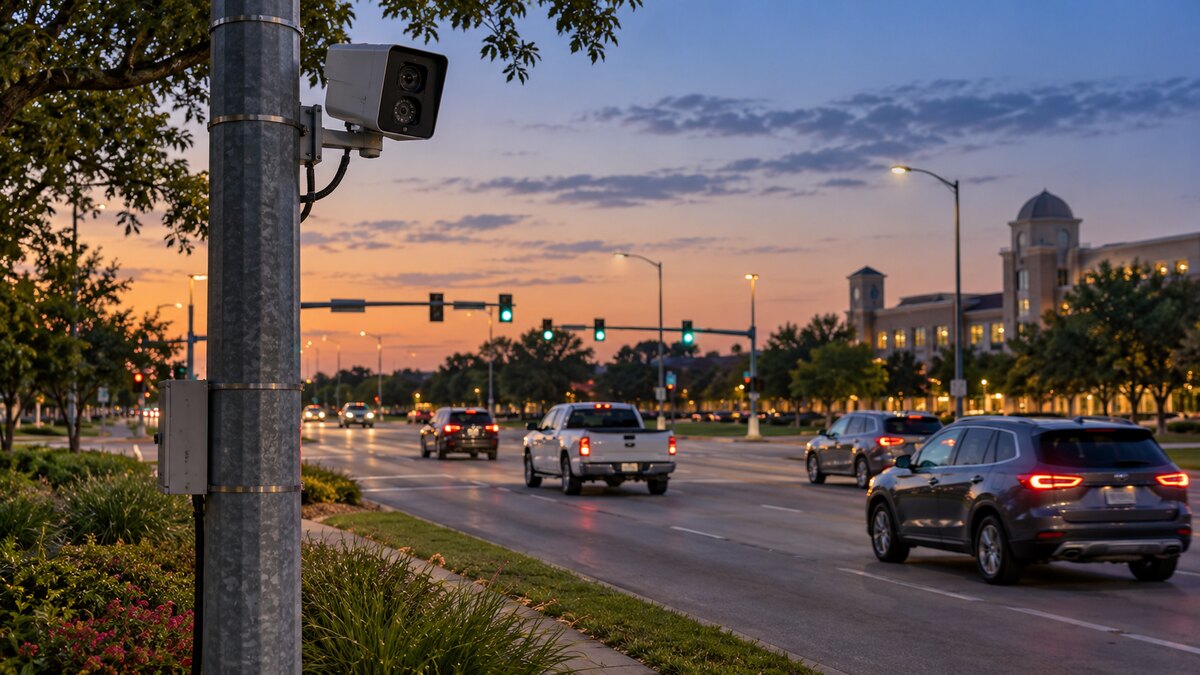
LEAGUE CITY, Texas — Voters in the Houston-area suburb will decide Tuesday whether police should continue operating 55 automated license-plate reader cameras along public roads, marking what The Texas Tribune reports is the first Texas election to let residents directly weigh the future of the technology.
Proposition A asks voters whether the League City Police Department should continue using fixed automated license-plate reader cameras for law-enforcement purposes. A “yes” vote supports continued use, while a “no” vote expresses a preference to end it, according to the city’s official election page.
The ballot question is formally nonbinding, but the City Council voted unanimously on Oct. 13 to honor a rejection. Under the approved resolution, city-owned roadway cameras must be removed, covered or bagged within 72 hours after the election results are officially canvassed if most voters choose “no.”
The cameras photograph passing vehicles and collect license-plate numbers, the date, time and location, along with characteristics such as a vehicle’s make, model, color and distinguishing marks. The police department says the system does not use facial recognition, identify drivers or passengers, record conversations or provide live video. It is not used to issue speeding or red-light tickets.
League City says vehicle images and location information are generally deleted after 30 days unless preserved as evidence in a criminal or administrative investigation. Authorized users must document a law-enforcement purpose for each search, and searches are logged and audited.
The city operates 55 cameras and has 16 more awaiting state highway permits, according to its public information page. Police also can access privately operated camera systems when homeowners associations or businesses voluntarily share their data. FOX 26 Houston reported that the department has access to 23 cameras managed by homeowners associations and six operated by businesses, while the city’s annual contract costs $175,000.
The debate places two public priorities in direct tension. Supporters say automated readers give investigators a faster way to locate vehicles associated with crimes, wanted people and public-safety alerts. Privacy advocates argue that recording every passing vehicle can create a detailed history of where residents travel, particularly when local systems are connected to wider law-enforcement networks.
League City says it shares its camera information with 436 Texas law-enforcement agencies and the FBI for legitimate investigations, but not with ICE, Border Patrol, businesses, homeowners associations or other private organizations. The city also says privately owned networks share data one way: police may query records made available by an owner, but private owners cannot search the police department’s system.
Although license plates are visible on public roads, the scale and automation of the technology have fueled debate nationwide about oversight, data retention and who can search collected information. The League City vote could provide a model for other Texas communities considering whether elected officials or residents should decide the future of these systems.
Election Day is Nov. 3. The final result will not be official until the city completes its canvass, which starts the 72-hour timetable if voters reject continued use.