









For generations, Black communities across the South built something powerful under conditions that were never fair: a self-sustaining economic ecosystem rooted in shared purpose, mutual trust, and collective survival. Segregated Black schools were not simply places of learning; they were community anchors. Teachers lived in the neighborhoods they served. Parents knew the principals personally. Money circulated within the community, reinforcing a collective cash flow and a shared “spirit” that prioritized group advancement over individual escape. This system was born out of exclusion, but it produced cohesion, pride, and economic continuity that many still remember today.
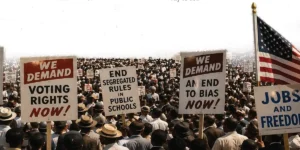
When court-ordered integration arrived, it was framed as progress—and in legal terms, it was necessary to dismantle explicit segregation. But the implementation in much of the South ignored a critical reality: integration was not accompanied by protection for Black institutions. Black schools were closed. Black principals were demoted or fired. Thousands of Black teachers lost their jobs. Students were bused out of their neighborhoods, often into hostile environments where they were not welcomed or supported. The result was not integration into power, but absorption into systems where Black influence diminished.
Economically, the damage was profound. Schools had been major employers and spending hubs in Black neighborhoods. Their closure meant fewer jobs, less local purchasing, and a breakdown of the internal circulation of money. The “collective cash flow spirit”—the idea that success for one was tied to success for all—was weakened as families were encouraged, implicitly and explicitly, to leave their communities behind in order to access opportunity elsewhere. Advancement became individual, not collective.
Culturally, the loss was just as severe. Black schools had reinforced identity, history, and responsibility to community. Integration often came with curricula and leadership that did not reflect Black experiences or values. Children learned to succeed in systems that rewarded assimilation, not community building. Over time, this shifted aspirations away from reinvestment in “the hood” toward exit strategies—get out, don’t build up.
None of this is an argument against equality or civil rights. It is an argument that the way integration was executed served white institutional stability far more than Black communal strength. True integration would have meant shared power, preserved institutions, and equitable investment. Instead, Black communities paid the price for a transition that dismantled their economic and social infrastructure without replacement.
Today, the consequences are visible in wealth gaps, underfunded schools, and neighborhoods stripped of anchors that once held them together. Understanding this history is not about blame for the sake of anger; it is about clarity. If we are serious about rebuilding Black economic power, we must learn from what was lost, recognize how policy decisions shaped outcomes, and intentionally restore systems that encourage collective ownership, local investment, and shared success. Only then can the spirit that once sustained Black communities be revived in a form strong enough for the future.