







There is a dangerous trend unfolding in this country — one that tells us the past is optional. That history is uncomfortable. That identity is divisive. That success alone is enough. But for Black America, we know better. We have always known better. You cannot move forward without knowing where you came from. This is not nostalgia. It is not romanticizing struggle. It is survival. It is strategy. It is truth.
Black progress in America has never been accidental. Every gain — from voting rights to educational access, from business ownership to political representation — was built on the shoulders of people who understood their history deeply. They knew the names. They knew the laws. They knew the barriers. And because they knew, they could organize, strategize, and push forward with clarity.
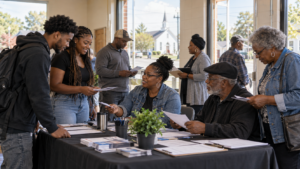
Today, our community stands at a complicated crossroads. On one hand, we are witnessing undeniable advancement. Black enrollment in higher education remains strong. Black entrepreneurs are launching businesses at record rates. Black voices are shaping culture, technology, media, and politics. We are present in spaces that once excluded us outright.
On the other hand, there is renewed resistance to how our history is taught, discussed, and understood. Across the country, debates over curriculum, diversity initiatives, and equity programs have intensified. There are efforts to narrow conversations about race and systemic inequality. In some classrooms, educators feel uncertain about how much truth they are permitted to tell. In boardrooms, diversity commitments are being questioned. In communities, economic disparities remain stubborn and persistent.
In moments like this, knowing our roots is not a luxury — it is protection. When you understand redlining, you better understand today’s housing gaps. When you understand voter suppression tactics of the past, you better recognize modern obstacles to ballot access. When you understand how education funding was historically unequal, you can more clearly see why disparities in school resources still exist. History provides context. Context provides clarity. Clarity provides power.
Without that foundation, progress can become fragile. There is a growing temptation, particularly among younger generations striving for upward mobility, to detach from struggle. To focus solely on personal advancement. To believe that degrees, titles, and income are the ultimate measures of success. And while ambition should be celebrated, ambition without awareness leaves gaps. It risks producing achievement without grounding.
You can earn a diploma and still not know the battles that made your enrollment possible. You can sit in a corporate office and still not understand the policies that once locked the door behind you. You can build wealth and still be unaware of the wealth that was systematically denied to your grandparents.
Forward motion without historical understanding can create distance from community. Our ancestors did not fight simply so we could succeed individually. They fought for collective mobility. They organized for community uplift. They demanded access not just for themselves, but for generations yet unborn. To move forward responsibly, we must carry that communal mindset with us.
Knowing where you came from does not mean staying stuck in trauma. It means recognizing resilience. It means honoring innovation born from necessity. It means understanding that our culture — our music, our language, our creativity, our faith, our organizing power — was forged under pressure and continues to shape the world.
It also means teaching our children more than surface- level celebration. Black history is not limited to a single month. It is not a collection of famous names and feel- good quotes. It is economic policy. It is civic engagement. It is cultural resistance. It is strategic brilliance. It is faith in action. As debates over education and representation continue nationwide, families and community leaders must double down on intentional teaching. Churches, barbershops, community centers, and homes must remain places where stories are preserved and truth is spoken. If formal systems narrow the lens, our community must widen it.
Moving forward requires tools. One of the most powerful tools we possess is memory. Memory reminds us that setbacks are not new. Memory reminds us that resilience is in our DNA. Memory reminds us that we have rebuilt before. When we understand how far we have traveled — from enslavement to entrepreneurship, from segregation to scholarship, from exclusion to influence — we walk differently. We negotiate differently. We vote differently. We build differently.
The future of Black America will be shaped by innovation, education, entrepreneurship, and leadership. But it must also be anchored in knowl- edge of origin. The young professional entering a new industry, the student step- ping onto a college campus, the family purchasing a first home — each is part of a longer story. Understanding that story transforms individ- ual success into generational progress.
You cannot move forward without knowing where you came from. To forget is to weaken your footing. To remember is to strengthen your stride. As we continue to navigate political shifts, economic uncertainty, and evolving cultural debates, let us resist the idea that the past is irrelevant. Our history is not baggage. It is blueprint. And blueprints are essential when you are building something meant to last.