








By: Roy Douglas Malonson
When you think of the Fourth of July, you prob- ably picture fireworks, backyard barbecues, and the red, white, and blue. We celebrate it because it marks the birth of the United States. On July 4, 1776, the founders of our country signed the Declaration of Independence, proudly stating that “all men are created equal” and have the right to “life, liberty, and the pursuit of happiness.”
But if you look closely at American history, you will see that this holiday has a much more complicated meaning for Black Americans. For over two hundred years, Black people have looked at the Fourth of July with a mix of feelings. It is a holi- day about freedom, but it is also a reminder of a time when freedom did not apply to everyone.
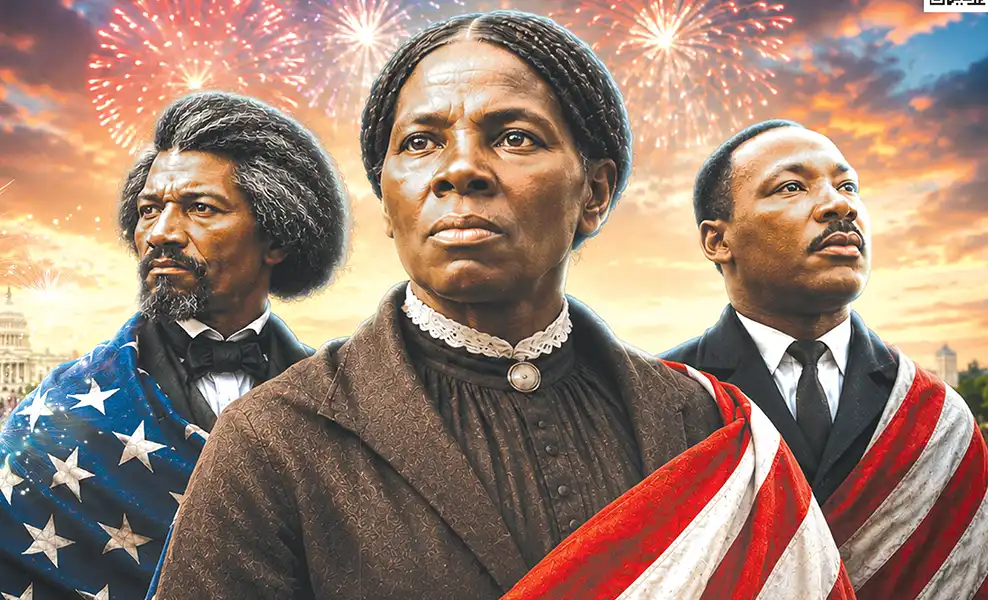
To understand why, we have to travel back in time to 1776. When the founders were writing those beautiful words about liberty, nearly half a million Black people were enslaved in the American colonies. They were treated as property, forced to work without pay, and had no rights at all. So, while white Americans were cheering because they were free from the King of England, enslaved Black Americans were still trapped in chains. For them, the loud cheers of Independence Day felt like a cruel reminder of what they were being denied. This feeling was explained perfectly by a famous Black leader named Frederick Douglass. He had escaped from slavery and became a powerful speaker and writer.
On July 5, 1852, he was invited to give a speech about the Fourth of July. Instead of just giving a standard patriotic speech, he asked a tough question: “What to the Slave Is the Fourth of July?” Douglass told the crowd that the holiday belonged to them, not to him. He explained that it was heartbreaking to hear a nation celebrate its freedom while millions of human beings were still held in slavery. His speech showed the deep irony of the holiday—the difference between what America promised on paper and what it actually did in real life. In fact, back in the 1800s, celebrating the Fourth of July could actually be dangerous for Black communities. White mobs would sometimes attack Black people who tried to gather for the holiday.
Because of this danger, many Black communities decided to celebrate on July 5th instead. It was safer, and it allowed them to have their own special day of reflection. Even though the holiday started with hypocrisy, Black Americans did not just give up on the Fourth of July or on America. Instead, they used the holiday as a tool to fight for their rights. For generations, Black activists, writers, and heroes used the Declaration of Independence to demand change. They argued that if America truly believed that “all men are created equal,” then the government had a duty to protect Black citizens, too. Black Americans have also earned their stake in this country through sacrifice.
Black soldiers fought in the Revolutionary War to help America win its independence. They fought in the Civil War to end slavery, and they fought in both World Wars to defend freedom around the globe. By fighting for the American flag, Black Americans proved that they were just as patriotic as anyone else. They were demanding that America live up to its promises. When Dr. Martin Luther King Jr. gave his famous “I Have a Dream” speech in 1963, he explicitly mentioned the Declaration of Independence, calling it a promise that should be kept for all people, Black and white alike.
In modern times, the way Black Americans view the Fourth of July has evolved, especially with the celebration of Juneteenth. Juneteenth, which happens on June 19th, marks the day in 1865 when the last enslaved people in Galveston, Texas, finally found out they were free. Today, many Black families see a balance between these two holidays. Juneteenth is celebrated as a day of true human freedom, remembering the end of slavery. The Fourth of July is celebrated as a day of political freedom, marking the birth of the nation. For many Black Americans, July 4th is a fun summer day spent with family, enjoying cookouts and community. But it is also a day to remember that freedom in America did not arrive all at once in 1776. It was something that had to be fought for, step by step, over a very long time.