







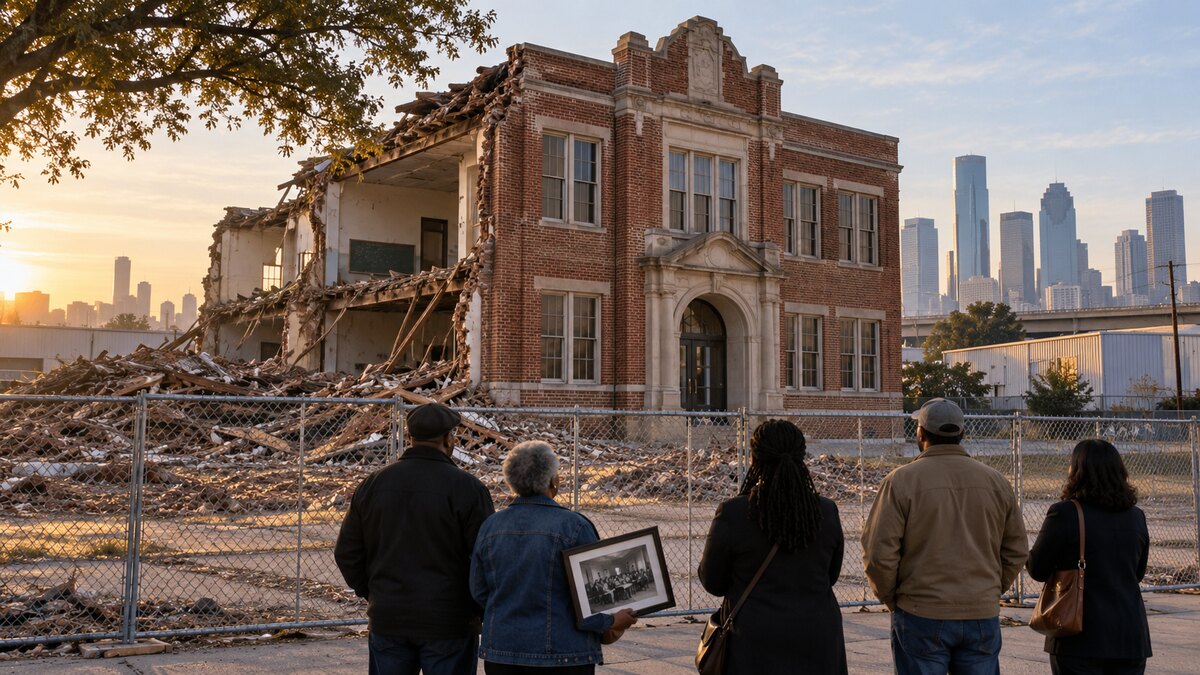
HOUSTON — Demolition is underway at the nearly century-old Harper School, one of the last remaining landmarks of Chaneyville, a historically Black community that once flourished near Washington Avenue.
Crews have torn down much of the abandoned brick building at 3200 Center Street, west of Studemont Street. By Sunday, Sept. 13, large sections had been reduced to rubble while part of the front facade remained standing, according to the Houston Chronicle.
The school was built in 1927 and served Black students during segregation. Houston Independent School District records say it was named for Frances Ellen Watkins Harper, the influential Black poet, author, abolitionist and suffragist who co-founded the National Association of Colored Women in 1894.
Harper School’s importance extends beyond the building itself. Preservation Houston identifies the property as a rare physical reminder of Chaneyville, a Black industrial neighborhood that developed during the late 19th and early 20th centuries. Much of that community’s original landscape has disappeared as Houston expanded and surrounding land uses changed.
HISD’s state-appointed Board of Managers approved selling the former campus in December 2025 as part of a larger sale of surplus district property. The buyer was BKR Memorial IV LLC, the Chronicle reported. The school had been vacant for years, and Harper’s disciplinary alternative education program moved to another campus in 2007.
A major fire damaged the abandoned building in late July, prompting renewed calls to preserve what could be saved. At the time, Houston Mayor John Whitmire described the property as an important part of the city’s Black history and said officials wanted to preserve the facade, historical marker and salvageable materials. A demolition permit was later issued.
Former students and preservation advocates now fear that the loss of the structure will make Chaneyville’s history even harder for future generations to see and understand. Some community members are asking that the site become protected green space if the remaining building cannot be preserved.
The demolition also renews a broader debate across Houston: how the city should balance redevelopment and private-property rights with the preservation of historic Black schools, neighborhoods and gathering places. Such sites often carry cultural value that is not captured by their current condition or commercial price.
Harper School’s namesake devoted her life to education, equality and justice. Supporters say any future use of the Center Street property should recognize both her legacy and the generations of Black Houston students who learned inside the building.
As demolition continues, it remains unclear whether the surviving facade, historical marker or building materials will be incorporated into a memorial or future development. Community advocates are urging the property owner and city leaders to ensure the site’s history is documented before the physical evidence disappears.
Sources: Houston Chronicle, Sept. 13, 2026; KHOU 11, Dec. 2025; Houston ISD school history.